
Reassurance-Seeking in Relationship OCD: Why It Backfires (and What to Do Instead)

By Brady Cleg, LCSW · Published August 22, 2026
Reassurance-seeking is a compulsion in which a person with relationship OCD (ROCD) repeatedly checks, by questioning their partner, polling friends, or searching online, whether their relationship or their feelings are “right.” The relief lasts minutes, but each check teaches the brain that the doubt was dangerous, so the anxiety returns stronger.
If you have relationship OCD, you already know the loop: a doubt spikes (“What if I don’t really love them?”), your chest tightens, and within minutes you’re asking your partner if things feel okay, rereading old texts, or typing “how do I know if I’m with the right person” into a search bar at 1 a.m. This post explains why that loop is the engine of ROCD, and gives you a concrete, therapist-designed plan for stepping out of it.
What reassurance-seeking looks like in ROCD
Reassurance-seeking isn’t always as obvious as asking “Do you love me?” It includes any repeated behavior whose real purpose is to make the doubt go away for a moment:
- Asking your partner variations of the same question, “Are we okay? Are you sure? But how do you know?”
- Confessing every intrusive doubt to your partner so they can talk you down
- Polling friends or family about whether your relationship seems healthy
- Searching the same questions online, or rereading articles about “signs you’re with the wrong person”
- Mentally reviewing dates, conversations, and feelings for “evidence” you’re in love
- Comparing your relationship to other couples, or your feelings today to your feelings last month
- Testing yourself: checking whether you feel a spark when you kiss, or whether someone else seems more attractive
The first few items involve other people; the last few happen silently. Both are compulsions, and both feed the disorder the same way.
Why it feels helpful, and why it backfires
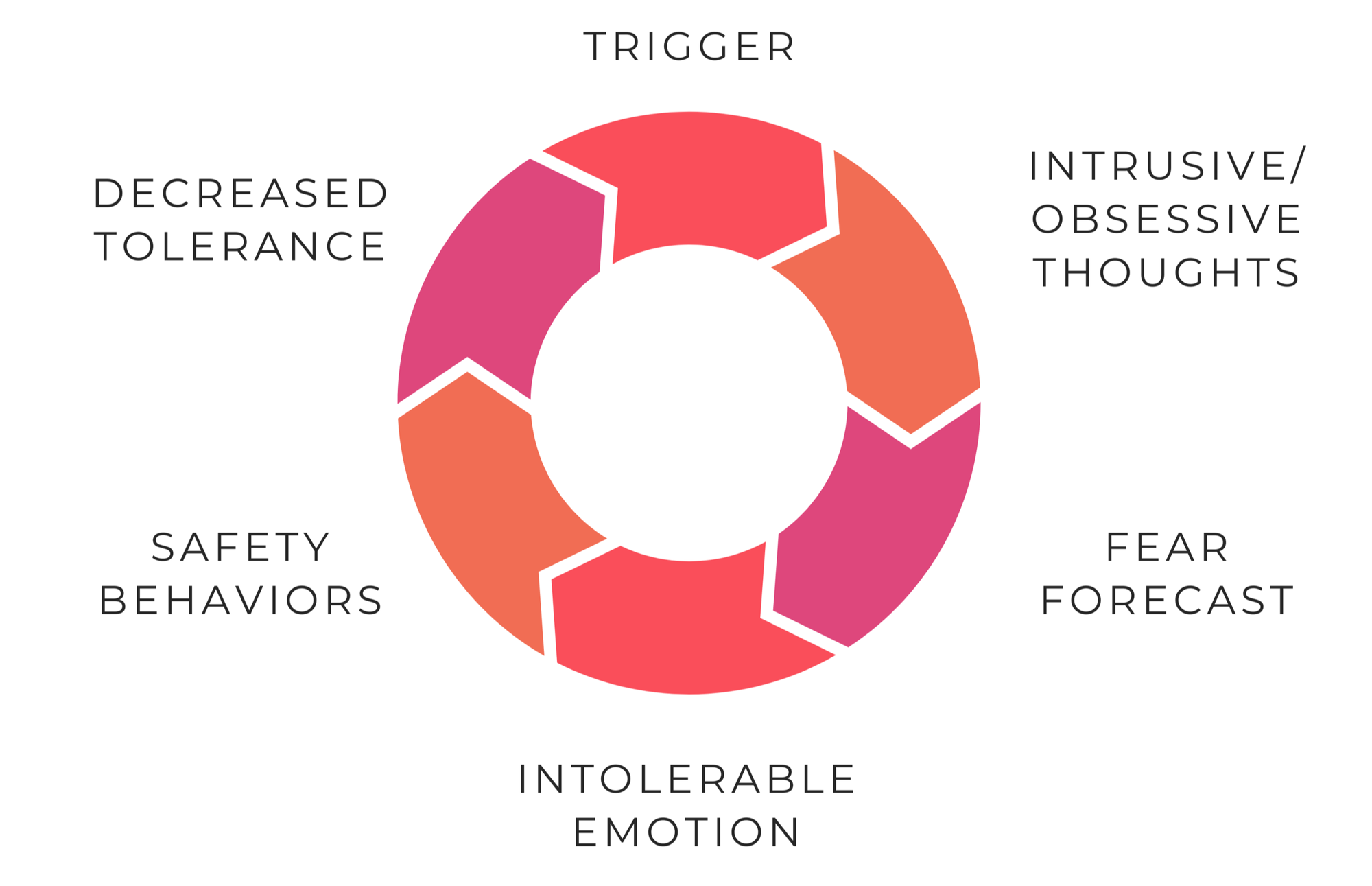
Reassurance works, briefly. That’s exactly the problem. OCD runs on a well-documented cycle:
- An obsession fires: an intrusive doubt about your relationship or your feelings.
- Anxiety spikes, because the thought attacks something you deeply value.
- A compulsion, asking, checking, reviewing, brings the anxiety down.
- Your brain records the lesson: that doubt was a real threat, and checking is how we survive it. The doubt returns sooner, louder, and needing more reassurance to settle.
Each cycle also erodes your confidence in your own judgment. The more often your partner’s answer settles you, the less you trust yourself to sit with an unanswered question, which is the exact skill recovery requires. Research on OCD consistently identifies reassurance-seeking as a maintaining factor: the disorder persists because of the checking, not despite it.
The hidden cost to your relationship
Partners of people with ROCD often become full-time answer machines. At first they’re glad to help; over months, the repeated questioning starts to feel like an accusation, as if the relationship itself is permanently on trial. Many partners report exhaustion, hurt, and the sense that no answer is ever enough (because, with OCD, no answer ever is). If your partner is in that spot, our companion post on supporting a partner with relationship OCD is written for them.
How to stop seeking reassurance: a 6-step plan
These steps come from exposure and response prevention (ERP), the first-line treatment for OCD. Start small, and expect it to feel uncomfortable; that discomfort is the treatment working.
- Name it out loud. When the urge hits, label it: “This is a reassurance compulsion, not a real question.” Naming the mechanism creates the half-second of distance you need to choose differently.
- Delay before you ask. You don’t have to resist forever, just wait 10 minutes, then 30, then an hour. Urges crest and fall on their own; delaying teaches your brain the anxiety passes without the ritual.
- Set a reassurance budget with your partner. Agree together on a limit, for example, one relationship-status question per day, and the answer only gets given once. This turns your partner from an answer machine into a recovery ally.
- Practice uncertainty statements. Instead of an answer, respond to the doubt with: “Maybe I love them, maybe I don’t. I’m not solving this today.” It feels wrong at first. That’s the point: you’re training tolerance for uncertainty, which is OCD’s real target.
- Redirect to values, not feelings. Feelings fluctuate; values don’t. Ask “What would a loving partner do in the next hour?” and do that: cook dinner, plan the weekend, put your phone down, regardless of what the doubt is saying.
- Track your wins. Keep a simple tally of urges you rode out without checking. Progress in OCD recovery is measured in resisted compulsions, not in absence of doubts.
Feel the loop for yourself
A doubt just fired. You get to choose what happens next — see what each choice teaches your brain.
“What if I don’t really love them?”
Your chest tightens. The urge to ask is rising. What do you do?
“But what if the doubt means something really is wrong?”
This is the question underneath every ROCD compulsion, so it deserves a direct answer: genuine relationship problems and ROCD feel different. Real concerns- incompatibility, mistreatment, divergent life goals- tend to be specific, stable, and clarifying to think about. ROCD doubts are repetitive, shape-shifting, and anxiety-soaked; the more you analyze, the less clear things get. A therapist trained in OCD can help you tell the two apart in an assessment, and no, treating your ROCD will not trick you into staying in a bad relationship. Treatment restores your judgment; it doesn’t override it.
When to get professional help
If reassurance-seeking is consuming an hour or more a day, straining your relationship, or you’ve tried to stop and can’t, it’s time to work with a specialist. The gold-standard treatment is exposure and response prevention (ERP), a structured therapy the International OCD Foundation reports helps the substantial majority of people who complete it — and studies suggest most people wait years before getting it. You don’t need to be one of them. Learn what treatment involves on our OCD treatment page.
Frequently asked questions
Is all reassurance bad in a relationship?
No. Occasional reassurance is a normal part of intimacy. It becomes a compulsion when the same question is asked repeatedly, the relief doesn’t last, and the need keeps growing. The pattern, not the question, is what defines it.
Should my partner just stop answering my questions?
Not abruptly, and not unilaterally. Sudden refusal usually spikes anxiety and conflict. The effective approach is a jointly agreed plan, a reassurance budget with warm but consistent limits; ideally set up with guidance from an OCD therapist.
What’s the difference between reassurance and support?
Support targets the person; reassurance targets the obsession. “I can see you’re anxious right now; I’m here” is support. “Yes, I’m sure we’re meant to be, I promise” is reassurance. Support helps recovery; reassurance feeds the cycle.
How long does it take to break the reassurance habit?
With consistent ERP practice, most people notice urges weakening within a few weeks, with meaningful change over two to four months. Progress depends far more on practicing between sessions than on time elapsed.
Can relationship OCD go away on its own?
Untreated OCD tends to wax and wane rather than resolve; stress typically brings it back. The reliable path is ERP with a therapist who knows ROCD. The skills, once learned, are yours for every future flare.
Work with an OCD specialist in Utah
Tangible Therapy has therapists trained in ERP and OCD treatment at our Provo, Orem, and Sandy offices, with telehealth available across Utah. Every new client starts with a free 15-minute consultation so you can find the right fit before committing to anything.
Call 435-260-5406 or schedule online with one of our OCD therapists.